Neutron: The Neutral Particle Inside an Atom
When we think about an atom, we often hear about protons, electrons, and neutrons. While electrons get much of the attention because they are involved in electricity and chemical reactions, neutron are just as important. These tiny particles help give atoms their mass and play a major role in keeping the atomic nucleus stable.
What Is a Neutron?
A neutron is a tiny subatomic particle found inside the nucleus of an atom. The most interesting thing about a neutron is that it has no electrical charge. Protons carry a positive charge, electrons carry a negative charge, but neutrons remain electrically neutral.
Neutrons are slightly heavier than protons. They are also made up of even smaller particles called quarks. A neutron contains two down quarks and one up quark, which are held together by a powerful force known as the strong nuclear force.
Why Are Neutrons Important?
Neutrons are essential for keeping the nucleus together. Since protons all have positive charges, they naturally push away from each other. Neutrons help strengthen the forces within the nucleus and contribute to its stability.
The number of neutrons can also change without changing the element itself. Atoms of the same element that contain different numbers of neutrons are called isotopes. Some isotopes are stable, while others are unstable and can undergo radioactive decay.
Neutron and Other Atomic Particles
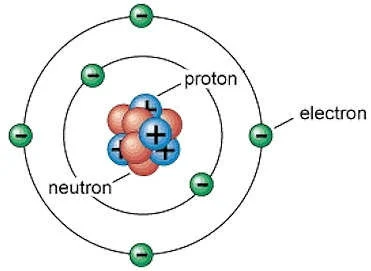
It is easier to understand a neutron by comparing it with the other major particles in an atom. Protons have a positive charge, electrons have a negative charge, and neutrons have no charge.
Protons and neutrons are located in the nucleus, while electrons are found around the nucleus. Although protons and neutrons have almost similar masses, an electron is much lighter.
How Are Neutrons Used?
Neutrons are useful in many areas of science and technology. Scientists use neutron-based techniques to study materials and understand the structure of atoms and molecules.
Neutrons are also important in nuclear fission. In certain nuclear reactions, a neutron can hit an atomic nucleus and cause it to split. This process releases energy and is used in nuclear power generation.
Conclusion
Although a neutron is incredibly small, its role in the atom is huge. It helps stabilize the nucleus, contributes to atomic mass, and makes different isotopes possible. Learning about neutrons gives us a better understanding of atoms, nuclear energy, and the basic structure of matter around us.